Fiber vs. 5G vs. Satellite Internet: Which Is Best for Your Home?
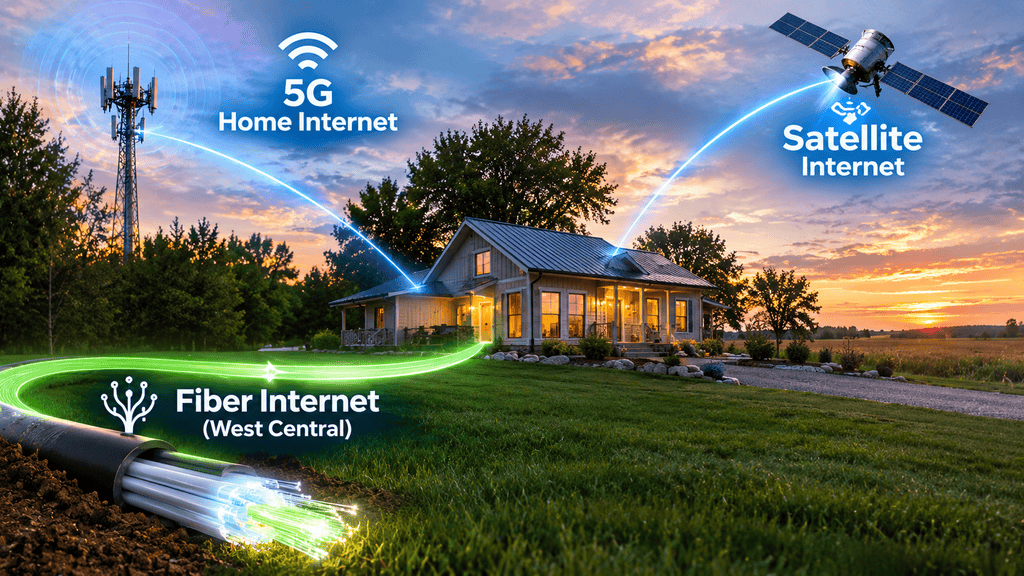
West Central Fiber vs. T-Mobile, Verizon, and Starlink
When it comes to home internet, there’s no shortage of options. From fiber-optic connections to 5G wireless networks and satellite internet, providers promise fast speeds, reliable service, and competitive prices.
But here’s the thing: Not all internet connections are created equal.
If you live in rural Minnesota, you’ve probably heard of West Central, T-Mobile Home Internet, Verizon 5G Home Internet, and Starlink. Each uses different technology to connect your home, and those differences can have a big impact on your online experience.
So, which is the best choice for your household?
Let’s break it down.
First, How Does Each Internet Technology Work?
Fiber Internet: A Direct Connection to Your Home
Fiber-optic internet transmits data using pulses of light through thin strands of glass.
Unlike wireless internet, which depends on radio signals traveling through the air, fiber provides a physical connection directly to your home.
At West Central, our 100% fiber-optic network delivers fast, symmetrical internet speeds. That means you can upload information just as quickly as you download it.
Whether you’re streaming your favorite show, working remotely, gaming online, or managing a house full of connected devices, fiber is built to handle today’s demands and tomorrow’s technology.
5G Home Internet: Connecting Through Cell Towers
T-Mobile and Verizon offer home internet services that use cellular networks rather than a physical fiber connection to your house.
A wireless gateway receives a signal from a nearby cell tower and distributes that connection throughout your home using Wi-Fi.
This makes installation relatively simple, often requiring little more than plugging in a gateway.
However, wireless performance can vary depending on several factors, including your distance from the tower, signal strength, network congestion, and your home’s location.
5G home internet can be a convenient option, but the strength of your connection depends partly on conditions outside your home.
Satellite Internet: Connecting From Space
Starlink takes a different approach.
Instead of using underground fiber lines or nearby cell towers, Starlink connects customers through a network of satellites orbiting Earth.
This technology has expanded internet access to remote locations where traditional wired connections may not be available.
However, satellite internet requires specialized equipment and a sufficiently clear view of the sky. Trees and other obstructions can interfere with the connection.
For households far beyond the reach of fiber or cellular networks, satellite internet can be an excellent alternative.
But what happens when all three options are available?
Let’s Compare: Fiber vs. 5G vs. Satellite
| Feature | West Central Fiber | T-Mobile & Verizon 5G | Starlink Satellite |
|---|---|---|---|
| Connection | Fiber-optic cable directly to your home | Wireless signal from cell towers | Wireless signal from satellites |
| Download speeds | Based on selected fiber plan | Varies by provider, plan, and location | Varies by plan and location |
| Upload speeds | Symmetrical with download speeds | Generally lower than download speeds | Generally lower than download speeds |
| Latency | Typically low | Varies with network conditions | Varies with satellite and network conditions |
| Signal considerations | No cellular signal or sky visibility required | Depends on cellular coverage and network conditions | Requires a clear view of the sky |
| Data | Unlimited on applicable West Central plans | Depends on plan and network policies | Depends on plan and applicable policies |
| Customer support | Local West Central team | National provider support | Starlink support |
| Installation | Professional fiber installation | Often self-installation | Satellite equipment installation |
Speeds and performance vary by service plan, location, equipment, and network conditions. Comparisons describe general technology characteristics rather than measured performance at a specific address.
Speed Matters. But Upload Speed Matters, Too.
When shopping for internet, most people focus on download speeds.
And that makes sense. Download speed determines how quickly you can stream movies, load websites, and download files.
But there’s another number that deserves just as much attention: upload speed.
Upload speed affects activities like:
- Video conferencing and working from home
- Uploading photos and videos
- Sending large files
- Backing up files to cloud storage
- Sharing content online
Many wireless and satellite internet services offer significantly slower upload speeds than download speeds.
West Central’s fiber network is different.
With symmetrical speeds, our 500 Mbps internet plan provides up to 500 Mbps for both downloading and uploading.
And our Gig internet delivers up to 1,000 Mbps in both directions.
That’s the advantage of a connection designed to handle data traveling both ways.
Actual speeds may vary based on equipment, network conditions, and other factors.
What About Gaming, Streaming, and Working From Home?
A fast download speed is great, but it doesn’t tell the whole story.
Another important factor is latency.
Latency measures how long it takes data to travel between your device and its destination. Lower latency generally means a more responsive connection.
For online gaming, video calls, and other real-time applications, that responsiveness matters.
Fiber-optic networks are designed to provide low-latency connections, making them an excellent choice for households with demanding internet needs.
5G and Starlink can also support gaming, streaming, and video conferencing. However, their performance can vary depending on signal quality, network conditions, and other factors.
Whether you’re competing in an online game, attending a virtual meeting, or streaming a movie, a strong connection helps keep things running smoothly.
What About the Price?
It’s tempting to choose whichever internet provider advertises the lowest monthly price.
But before making a decision, consider what you’re getting for that price.
How fast are the download and upload speeds?
Two plans with similar monthly prices may offer very different upload performance.
Is the advertised price temporary?
Check whether a promotional rate expires, what conditions apply, and whether a price guarantee is included.
Are there equipment or installation costs?
Some providers include equipment, while others may have upfront charges.
What happens when you need help?
Customer support is another important part of the value you’re receiving.
At West Central, we believe internet service should be about more than a number on your monthly bill.
It should be about getting a connection you can count on, backed by people who care about keeping you connected.
The West Central Difference: Big-Time Internet. Small-Town Service.
Technology is only part of the equation.
West Central isn’t a national telecommunications giant. We’re a locally rooted, member-owned cooperative serving communities throughout central Minnesota.
Our mission goes beyond delivering internet service. We’re here to help the communities we serve stay connected, grow, and thrive.
That means investing in fiber infrastructure, supporting local organizations, and providing customer service from people who understand the communities we call home.
When you contact West Central, you’re connecting with a local team.
And when you choose West Central, you’re supporting a cooperative committed to the future of rural Minnesota.
That’s the difference between simply providing a connection and building a connected community.
More Than an Internet Provider. We’re Your Neighbors.
At West Central, being local means more than having an office down the road. It means being part of the same communities, supporting the same schools, cheering on the same teams, and looking out for the people who call this place home.
We’re not just here to provide internet. We’re here to help our communities grow and thrive.
A Cooperative That Gives Back to Its Members
One of the biggest differences between West Central and national internet providers is that we’re a member-owned cooperative.
Unlike traditional corporations that distribute profits to outside shareholders, cooperatives operate for the benefit of their members.
That’s where capital credits come in.
When West Central earns more revenue than it needs to cover operating expenses, those margins may be allocated to eligible cooperative members as capital credits. Over time, the cooperative’s Board of Directors determines when those credits can be returned to members, based on the financial health and needs of the cooperative.
In other words, being part of West Central means you may share in the cooperative’s financial success.
It’s one of the ways our cooperative structure puts members first.
Capital credits are available to eligible cooperative members, not necessarily all internet customers. Allocations and distributions are subject to cooperative policies and Board authorization.
Investing in the Communities We Call Home
We believe strong communities are built by people who show up for one another.
That’s why our commitment doesn’t stop at providing fast, reliable internet.
From supporting local schools and youth programs to sponsoring community events, providing scholarships, and partnering with organizations that make a difference, West Central believes in giving back.
Not because we have to, but because these are our communities, too.
Our employees live here. We raise our families here. We shop at the same businesses, attend the same community events, and share the same hopes for the future of rural Minnesota.
We believe in building each other up, taking care of our neighbors, and investing in the places we call home.
Because when our communities succeed, we all succeed.
Your Connection Makes a Difference
Choosing an internet provider is usually about finding the right speed, price, and reliability.
And those things matter.
But with West Central, your connection represents something more.
It’s a connection to a local cooperative that believes in its members, invests in its communities, and understands that the best way to build a brighter future is to build it together.
We’re not just connecting homes and businesses. We’re connecting neighbors, strengthening communities, and investing in the place we all call home.
That’s what makes West Central different.
So, Which Internet Is Right for You?
The answer depends on where you live and how you use the internet.
Fiber internet is an excellent choice if:
You want fast download and upload speeds, low latency, and a direct connection to your home. It’s particularly well suited for families, remote workers, gamers, and households with multiple connected devices.
5G home internet may be a good choice if:
You want a relatively simple setup, have strong cellular coverage, and your household’s internet needs fit the available wireless speeds.
Satellite internet may be a good choice if:
You live in a remote location where fiber or other reliable broadband options aren’t available.
All three technologies have their place.
But when a direct fiber connection is available, it offers compelling advantages in speed, upload performance, and responsiveness.
Ready for a Better Connection?
At West Central, we’re proud to bring future-ready fiber internet and local customer service to the communities we serve.
Whether you’re working from home, streaming with family, gaming with friends, or simply staying connected to what matters most, we’re here to help.
And when you choose West Central, you’re choosing more than an internet provider. You’re choosing a local partner that believes in building stronger communities together.
Big-time technology. Small-town service. A connection that gives back.
That’s West Central.
We Connect You.
Visit wcta.net to explore our internet options and check availability in your area.
Installation and Repair Technician II
Are you passionate about hands-on problem solving, working outdoors, and keeping your community connected? West Central is looking for an Install & Repair Technician II to join our team and deliver reliable, high-quality service to the customers who count on us every day.
We’re looking for someone who takes pride in their work and enjoys tackling technical challenges in the field. In this role, you’ll install, maintain, and repair broadband and communication services for residential and business customers. Responsibilities include troubleshooting service issues, performing installations and upgrades, maintaining network equipment, and ensuring every connection meets West Central’s high standards. You’ll work independently and as part of a team, all while providing a positive, professional experience for our customers.
Outstanding benefits, paid holidays, and time off, and more make this a great opportunity! To apply, send your resume to hr@wcta.net. Job open until April 10, 2026. EOE
Have You Received Your Capital Credit Check?
One of the benefits of joining our cooperative is that each year we’re successful, members are rewarded with cash back in the form of capital credits. Some members move out of the area but forget to give us an updated address, or a member may no longer be living. In either case, the checks are returned to us.
Are you one of the many individuals whose capital credit check has been returned to us due to an outdated address? If you’re a former customer of our cooperative, we may have your money.
- ARMSTRONG JEREMY M / KASEE
- BACHMANN JASON
- BAKKEN KENNETH R
- BARBEE MARY
- BEACHAM RUTH
- BLAIR DONALD
- BOWEN TERRY
- BOYER ETHAN
- BULLOCK JESSICA / JESSE
- BURKE BRET
- BUSSART TOMMIE
- CALLIER MICHAEL
- CHRISTIANSEN JOYCE
- CLEVELAND MARSHA
- CORBIN VEITA LOU
- CROOKER ALLEN / BARKER JANELLE
- CROW WING CONSULTING
- CUPERUS MAGGIE
- DAILEY HENRY / DIANE
- DAUGHERTY KENNETH
- DEMARCO BLANCA
- DENNY JOYCE
- EASTMAN KRISTI
- ECKMAN ADRIAN / LISA
- ELFSTRUM MIKE / JEANIE
- ENGEBRETSON JACOB
- GERSZEWSKI TOM
- GOTCHIE STEVEN / REBECCA
- GRATON CINDY
- GRIFFITH GERALD
- HAHN HOWARD
- HILLUKKA JEFF
- HOGAN MATTHEW / RACHAEL
- HORTON RUTH
- JACOBSON BRUCE
- JOHNSON LINDSEY
- JOKELA SHANIAH
- KERN LOIS
- KOK RICHARD / KAREN
- KUEKER ERIC
- LALUM KAREN
- LARSON MELISA
- LERITZ FRANCINE
- LIGHT ROBERT
- LINCOLN DANIEL
- LOERZEL JAY
- MILLER TOM / BETH
- NESS BILL / LAURIE
- NEVALA-LOPER DAWNE
- NIELSON TERRI
- OLSON BRADLEY
- OVERBY DAWN
- PATCHWORK PARLOR
- PEDERSON CHRISTINA
- PEDERSON RYAN / BARBARA
- PICKAR JOANNE
- RAUTIO ROBIN
- ROCKY ACRES
- RYKS SARAH
- SAMUELSON MICHELLE
- SCHMITZ MICHAEL
- SEALS MENA
- SHARP DARYL
- SHARSTROM DEBRA / BRAUM
- SHEPERSKY LAURA
- SHREVES JENNIFER
- SILTALA AARON
- STARK JOSH / TATIANA
- SUHL BRENDA
- THOMPSON KENNETH / MAXINE
- TOSO DANIEL
- TRUAX TREVOR
- VANDERHEYEN CARRIE
- WEBER WILLIAM & JULIE
- WORTHY WALTER / BEVERLY
- WRIGHT KENT
For a Good Cause 10-Digit Dialing Must Start
| For a good cause… ten-digit dialing must be implemented in all areas of the U.S. This is due to technical reasons supporting the new Federal Communications Commission (FCC) directive adopting 988 as the three-digit number to be used nationwide to reach the National Suicide Prevention and Mental Health Crisis Lifeline. For 988 to work in the 218-area code, 10-digit local dialing must first be implemented, which means you will need to change the way you dial local calls. The 988 hotline is starting July 16, 2022. Customers should continue to dial 1-800-273-TALK to reach the Lifeline until July 16, 2022. What will be the new dialing procedure? To complete all local calls, you will now need to dial 218 + telephone number. This applies to all calls within your area code that are currently dialed with seven digits. Who will be affected? Anyone with a telephone number with the area code 218 will need to make this change from 7-digit local dialing to 10-digit local dialing. When will the change begin? Beginning April 24, 2021, you can and should begin dialing 10 digits (218 + telephone number) for all local calls. If you forget and dial just 7 digits, for now, your call will still be completed. Beginning January 1, 2022, you must dial 10-digits (218 + telephone number) for all local calls. On and after this date, local calls dialed with only 7-digits may not be completed, and a recording will inform you that your call cannot be completed as dialed. You must hang up and dial again using the area code and the 7-digit number. Reprogram Your Auto Dialers In addition to changing the way you dial local calls, all services, automatic dialing equipment, or other types of equipment that are programmed to complete calls to 7-digit local numbers will need to be reprogrammed to complete calls to 10-digit numbers. Some examples are life safety systems or medical monitoring devices, PBXs, fax machines, Internet dial-up numbers, fire or burglar alarm and security systems or gates, speed dialers, mobile or other wireless phone contact lists, call forwarding settings, voicemail services and other similar functions. Be sure to check your website, personal and business stationery, advertising materials, personal and business checks, contact information, your personal or pet ID tags, and other such items to ensure the area code is included. What will remain the same? • Your telephone number, including current area code, will not change. • The price of a call, coverage area, or other rates and services will not change due to the dialing change. • What is a local call now will remain a local call regardless of the number of digits dialed. • You will continue to dial 1+ area code + telephone number for all long-distance calls. • You can still dial just three digits to reach 711 (relay services) and 911 (emergency services). • 211, 411, 511, 611, or 811 services can still be reached by dialing their three-digit codes. • The National Suicide Prevention Lifeline can still be reached by dialing 1-800-273-TALK (8255). Who may you contact with questions? If you have any questions regarding information provided in this notice, please call our office at 218-837-5151 or access www.wcta.net for more information. You can also visit the FCC website. And remember, if you or anyone you know needs it, beginning July 16, 2022, dialing “988” will quickly route your call to National Suicide Prevention and Mental Health Crisis Lifeline. For more information see the FCC Announcement. |