Fiber vs. 5G vs. Satellite Internet: Which Is Best for Your Home?
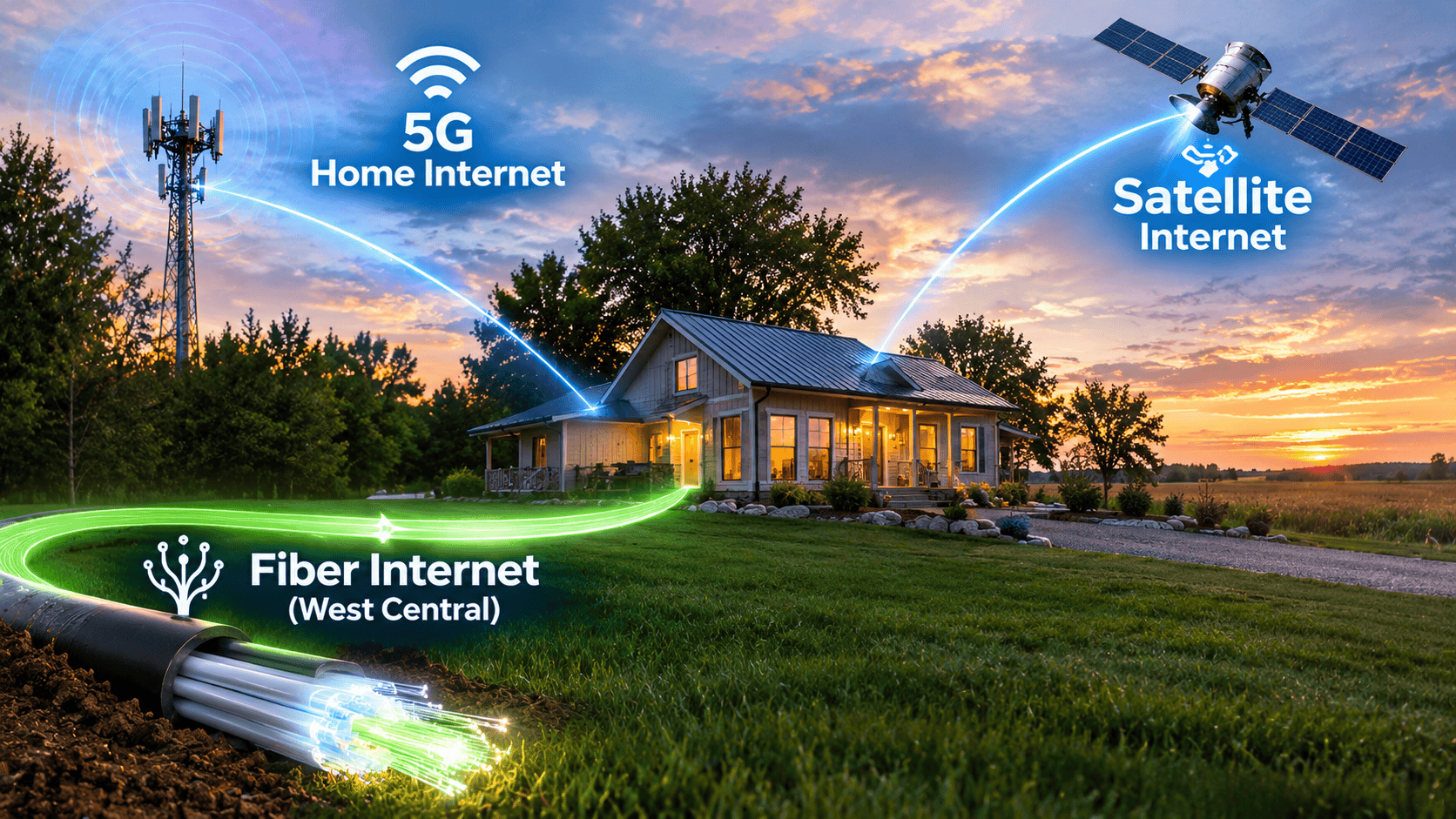
West Central Fiber vs. T-Mobile, Verizon, and Starlink
When it comes to home internet, there’s no shortage of options. From fiber-optic connections to 5G wireless networks and satellite internet, providers promise fast speeds, reliable service, and competitive prices.
But here’s the thing: Not all internet connections are created equal.
If you live in rural Minnesota, you’ve probably heard of West Central, T-Mobile Home Internet, Verizon 5G Home Internet, and Starlink. Each uses different technology to connect your home, and those differences can have a big impact on your online experience.
So, which is the best choice for your household?
Let’s break it down.
First, How Does Each Internet Technology Work?
Fiber Internet: A Direct Connection to Your Home
Fiber-optic internet transmits data using pulses of light through thin strands of glass.
Unlike wireless internet, which depends on radio signals traveling through the air, fiber provides a physical connection directly to your home.
At West Central, our 100% fiber-optic network delivers fast, symmetrical internet speeds. That means you can upload information just as quickly as you download it.
Whether you’re streaming your favorite show, working remotely, gaming online, or managing a house full of connected devices, fiber is built to handle today’s demands and tomorrow’s technology.
5G Home Internet: Connecting Through Cell Towers
T-Mobile and Verizon offer home internet services that use cellular networks rather than a physical fiber connection to your house.
A wireless gateway receives a signal from a nearby cell tower and distributes that connection throughout your home using Wi-Fi.
This makes installation relatively simple, often requiring little more than plugging in a gateway.
However, wireless performance can vary depending on several factors, including your distance from the tower, signal strength, network congestion, and your home’s location.
5G home internet can be a convenient option, but the strength of your connection depends partly on conditions outside your home.
Satellite Internet: Connecting From Space
Starlink takes a different approach.
Instead of using underground fiber lines or nearby cell towers, Starlink connects customers through a network of satellites orbiting Earth.
This technology has expanded internet access to remote locations where traditional wired connections may not be available.
However, satellite internet requires specialized equipment and a sufficiently clear view of the sky. Trees and other obstructions can interfere with the connection.
For households far beyond the reach of fiber or cellular networks, satellite internet can be an excellent alternative.
But what happens when all three options are available?
Let’s Compare: Fiber vs. 5G vs. Satellite
| Feature | West Central Fiber | T-Mobile & Verizon 5G | Starlink Satellite |
|---|---|---|---|
| Connection | Fiber-optic cable directly to your home | Wireless signal from cell towers | Wireless signal from satellites |
| Download speeds | Based on selected fiber plan | Varies by provider, plan, and location | Varies by plan and location |
| Upload speeds | Symmetrical with download speeds | Generally lower than download speeds | Generally lower than download speeds |
| Latency | Typically low | Varies with network conditions | Varies with satellite and network conditions |
| Signal considerations | No cellular signal or sky visibility required | Depends on cellular coverage and network conditions | Requires a clear view of the sky |
| Data | Unlimited on applicable West Central plans | Depends on plan and network policies | Depends on plan and applicable policies |
| Customer support | Local West Central team | National provider support | Starlink support |
| Installation | Professional fiber installation | Often self-installation | Satellite equipment installation |
Speeds and performance vary by service plan, location, equipment, and network conditions. Comparisons describe general technology characteristics rather than measured performance at a specific address.
Speed Matters. But Upload Speed Matters, Too.
When shopping for internet, most people focus on download speeds.
And that makes sense. Download speed determines how quickly you can stream movies, load websites, and download files.
But there’s another number that deserves just as much attention: upload speed.
Upload speed affects activities like:
- Video conferencing and working from home
- Uploading photos and videos
- Sending large files
- Backing up files to cloud storage
- Sharing content online
Many wireless and satellite internet services offer significantly slower upload speeds than download speeds.
West Central’s fiber network is different.
With symmetrical speeds, our 500 Mbps internet plan provides up to 500 Mbps for both downloading and uploading.
And our Gig internet delivers up to 1,000 Mbps in both directions.
That’s the advantage of a connection designed to handle data traveling both ways.
Actual speeds may vary based on equipment, network conditions, and other factors.
What About Gaming, Streaming, and Working From Home?
A fast download speed is great, but it doesn’t tell the whole story.
Another important factor is latency.
Latency measures how long it takes data to travel between your device and its destination. Lower latency generally means a more responsive connection.
For online gaming, video calls, and other real-time applications, that responsiveness matters.
Fiber-optic networks are designed to provide low-latency connections, making them an excellent choice for households with demanding internet needs.
5G and Starlink can also support gaming, streaming, and video conferencing. However, their performance can vary depending on signal quality, network conditions, and other factors.
Whether you’re competing in an online game, attending a virtual meeting, or streaming a movie, a strong connection helps keep things running smoothly.
What About the Price?
It’s tempting to choose whichever internet provider advertises the lowest monthly price.
But before making a decision, consider what you’re getting for that price.
How fast are the download and upload speeds?
Two plans with similar monthly prices may offer very different upload performance.
Is the advertised price temporary?
Check whether a promotional rate expires, what conditions apply, and whether a price guarantee is included.
Are there equipment or installation costs?
Some providers include equipment, while others may have upfront charges.
What happens when you need help?
Customer support is another important part of the value you’re receiving.
At West Central, we believe internet service should be about more than a number on your monthly bill.
It should be about getting a connection you can count on, backed by people who care about keeping you connected.
The West Central Difference: Big-Time Internet. Small-Town Service.
Technology is only part of the equation.
West Central isn’t a national telecommunications giant. We’re a locally rooted, member-owned cooperative serving communities throughout central Minnesota.
Our mission goes beyond delivering internet service. We’re here to help the communities we serve stay connected, grow, and thrive.
That means investing in fiber infrastructure, supporting local organizations, and providing customer service from people who understand the communities we call home.
When you contact West Central, you’re connecting with a local team.
And when you choose West Central, you’re supporting a cooperative committed to the future of rural Minnesota.
That’s the difference between simply providing a connection and building a connected community.
More Than an Internet Provider. We’re Your Neighbors.
At West Central, being local means more than having an office down the road. It means being part of the same communities, supporting the same schools, cheering on the same teams, and looking out for the people who call this place home.
We’re not just here to provide internet. We’re here to help our communities grow and thrive.
A Cooperative That Gives Back to Its Members
One of the biggest differences between West Central and national internet providers is that we’re a member-owned cooperative.
Unlike traditional corporations that distribute profits to outside shareholders, cooperatives operate for the benefit of their members.
That’s where capital credits come in.
When West Central earns more revenue than it needs to cover operating expenses, those margins may be allocated to eligible cooperative members as capital credits. Over time, the cooperative’s Board of Directors determines when those credits can be returned to members, based on the financial health and needs of the cooperative.
In other words, being part of West Central means you may share in the cooperative’s financial success.
It’s one of the ways our cooperative structure puts members first.
Capital credits are available to eligible cooperative members, not necessarily all internet customers. Allocations and distributions are subject to cooperative policies and Board authorization.
Investing in the Communities We Call Home
We believe strong communities are built by people who show up for one another.
That’s why our commitment doesn’t stop at providing fast, reliable internet.
From supporting local schools and youth programs to sponsoring community events, providing scholarships, and partnering with organizations that make a difference, West Central believes in giving back.
Not because we have to, but because these are our communities, too.
Our employees live here. We raise our families here. We shop at the same businesses, attend the same community events, and share the same hopes for the future of rural Minnesota.
We believe in building each other up, taking care of our neighbors, and investing in the places we call home.
Because when our communities succeed, we all succeed.
Your Connection Makes a Difference
Choosing an internet provider is usually about finding the right speed, price, and reliability.
And those things matter.
But with West Central, your connection represents something more.
It’s a connection to a local cooperative that believes in its members, invests in its communities, and understands that the best way to build a brighter future is to build it together.
We’re not just connecting homes and businesses. We’re connecting neighbors, strengthening communities, and investing in the place we all call home.
That’s what makes West Central different.
So, Which Internet Is Right for You?
The answer depends on where you live and how you use the internet.
Fiber internet is an excellent choice if:
You want fast download and upload speeds, low latency, and a direct connection to your home. It’s particularly well suited for families, remote workers, gamers, and households with multiple connected devices.
5G home internet may be a good choice if:
You want a relatively simple setup, have strong cellular coverage, and your household’s internet needs fit the available wireless speeds.
Satellite internet may be a good choice if:
You live in a remote location where fiber or other reliable broadband options aren’t available.
All three technologies have their place.
But when a direct fiber connection is available, it offers compelling advantages in speed, upload performance, and responsiveness.
Ready for a Better Connection?
At West Central, we’re proud to bring future-ready fiber internet and local customer service to the communities we serve.
Whether you’re working from home, streaming with family, gaming with friends, or simply staying connected to what matters most, we’re here to help.
And when you choose West Central, you’re choosing more than an internet provider. You’re choosing a local partner that believes in building stronger communities together.
Big-time technology. Small-town service. A connection that gives back.
That’s West Central.
We Connect You.
Visit wcta.net to explore our internet options and check availability in your area.